
You Can't Change What You Don't Notice

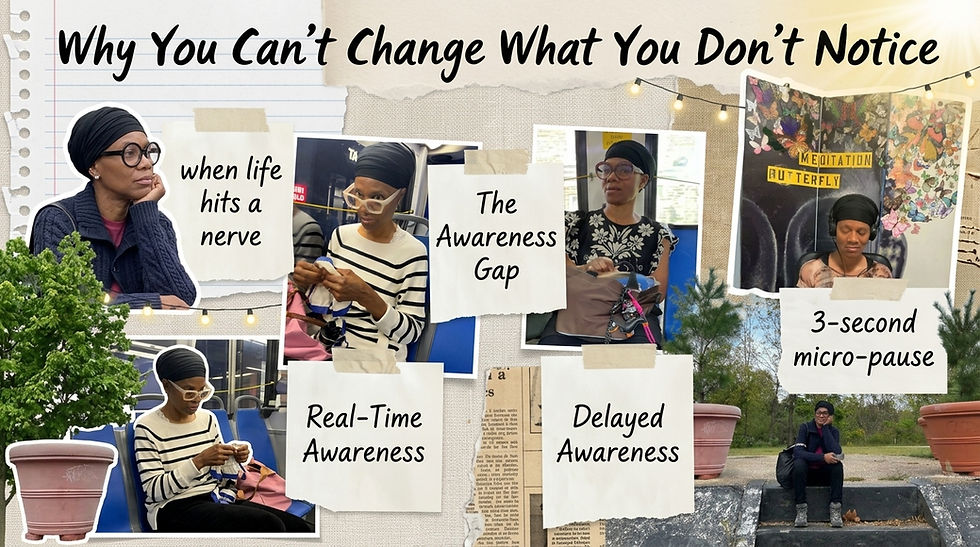
You’ve read all the books. You know all of your triggers. You can even explain a few with textbook precision. And yet, when life hits a nerve, you still find yourself slipping into the exact same reaction you promised yourself to outgrow.
Afterward, the frustration sets in and you say to yourself:
“I know better than this… Why did I do that again?”
This is The Awareness Gap… The distance between recognizing your patterns after the fact (Delayed Awareness) and catching them in the heat of the moment (Real-Time Awareness).
The truth is simple:
You cannot accept or transform what you do not notice WHILE IT’S HAPPENING.
When you notice a trigger as it arises, you create a tiny sliver of space between stimulus and response. And as author and Holocaust-survivor Victor Frankel so eloquently points out: “In that space lies our power to choose (our response)”.
The Limits of Journaling
Most growth-oriented people mistake the act of journaling about their behavior as the only act needed to transform it.
Journaling is great..! In fact, it's one of the key habits (ie REFLECTION) of the MB Method. But journaling is the act of analyzing your life in hindsight. With journaling, you always review your reactions like a post-game video.
And, no matter how insightful that journaling may be, it's not the same as “playing the game” on the field of Life in real-time.
That's why the MB Method helps you develop both types of Awareness (Delayed and Real-Time) for successful life-changes. The method may emphasize the habit of Reflection (ie journaling), but that is only half of the equation.
So… Let’s talk about the other half..!
3-Steps to Close the Gap
To close the Awareness Gap, you don't need more theory… But you DO need a practical mechanism to catch yourself in real time.
STEP 1. PAUSE and Create Space
When a trigger lands in real-time, your nervous system wants to rush into an automatic reaction… defending, withdrawing, or over-explaining…
At that very moment... PAUSE..!
Your New Habit: Build a 3-second micro-pause. This interrupts the loop of automatic reactivity and snaps your awareness back to the present. Here's a few options to tryout:
Take one slow, deep breath
Close your eyes or lower your gaze for 3 seconds
Softly wiggle your fingers or toes
Slowly (or quickly) Rub your hands together
STEP 2. Observe Without Judgment
Before you try to fix or change how you feel, simply notice it.
Your New Habit: Name your experience with neutral, fact-based statements such as: "I notice a tightening in my chest," or "I am noticing an urge to argue back." or even “I feel my hands forming a fist” (which is very common, even in non-physical altercations).
When you observe without judgment, you step into radical acceptance and stop wasting energy trying to fight the feeling. This act of “observing before reacting” helps you see the entire situation more clearly.
STEP 3. Choose a Reframing Response
Once you have observed the sensation without absorbing it, you regain power over your actions. After practicing steps 1 and 2 a few times, you can now choose a totally new real-time response to any stressful situation.
Your New Habit: After pausing and observing yourself in a stressful moment, ask yourself one simple question: "What response aligns with who I choose to be right now?". Asking yourself this question repeatedly will enhance your ability to “master the moment”.
A Reflection Challenge for Your Week
Always remember that true personal growth requires building Awareness both “off the field” and “on the field”.
So… Take a moment this week to reflect (and act upon):
"Where in my life do I know better, but still fall into old habits in the moment?"
and
What micro-pause can I use before a default reaction takes over?
Take Care, and Be Blessed..!
P.S. If this resonates with you, share your thoughts in the comments below or reply directly to this email—I’d love to hear what micro-pause(s) you use to bring yourself back to awareness.


Comments